

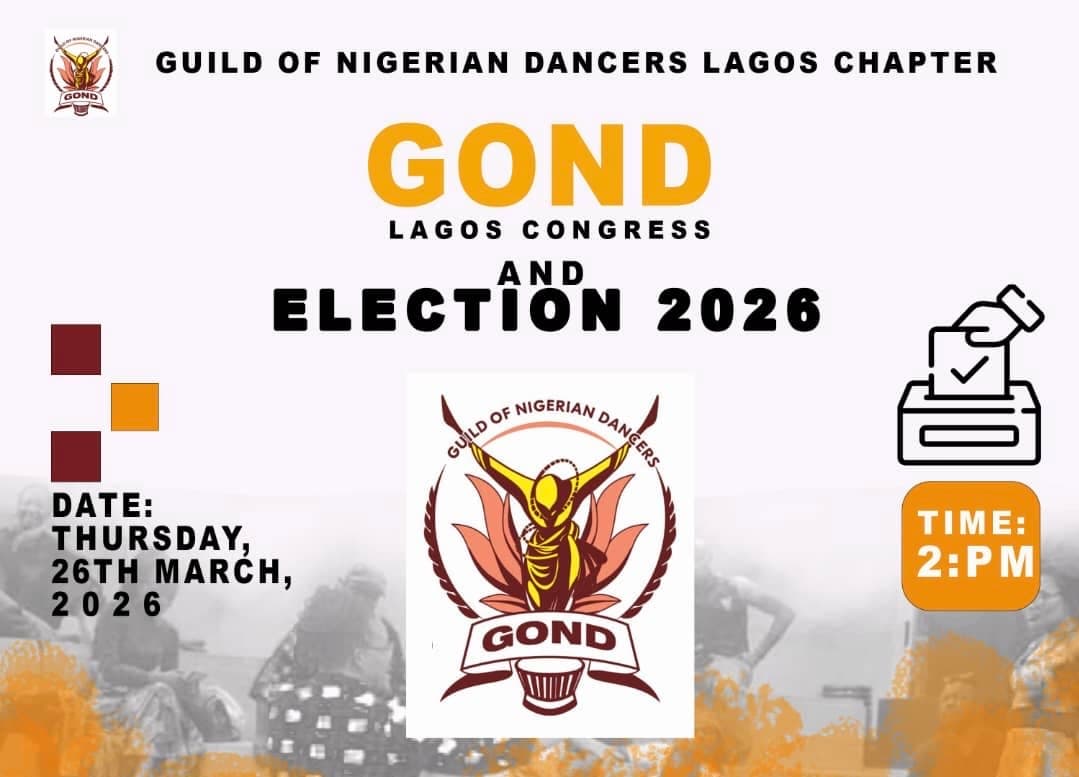
For many dancers in Lagos, the just-concluded Guild of Nigeria Dancers (GOND) Lagos chapter election felt like a wasted effort. Time was spent, energy gathered, and yet, to them, little seems likely to change.
For others, it marked something more fragile, but more hopeful. A step toward structure. Toward representation. Toward the possibility of infrastructure, institutional backing, protection, and perhaps, long-delayed national recognition for dance as an industry.
Both views sit side by side. Neither cancels the other.
What cannot be dismissed, however, is this: for the first time, the Guild of Nigerian Dancers held an open election. That alone signals a shift, however tentative, in how decisions might begin to be made within Nigeria’s dance community.
Obiajulu Ozegbe emerged as Chairman, becoming the youngest practicing dancer to hold the position. His victory came unopposed after two contenders stepped down, so there was little real competition in the end.
He now leads an executive team made up of different generations, suggesting an attempt at balance, even if how that will work in practice remains to be seen.
The election took place on March 26, 2026, at the John K. Randle Centre for Yoruba History and Culture, a space known for its cultural significance. The centre, under the artistic direction of renowned dancer and choreographer Qudus Onikeku, has become an important hub for dance in the city.
But what stood out most that day was not the venue. It was the turnout.
From Bariga to Ajegunle, from Agiliti to Oworo and Surulere, dancers showed up in numbers that the Guild’s regular congresses have rarely seen. It was a clear act of presence.
It raises an important question: Where have these dancers been during previous meetings? Or more precisely, what made it possible for them to show up now?
The election filled multiple roles within the Guild: Vice Chairman, Secretary, Financial Secretary, Head of Production, Director of Business Development, Treasurer, State Director of Welfare, Director of Children and Youth Development, and Publicity Secretary.
Some positions were contested. Others were not.
Vivian Akorede Obianuju secured the Vice Chairmanship after a three-way race. Osilike Ann emerged as Financial Secretary, while Deborah Ayegbeni took the Head of Production role.
Several offices, including Business Development, Treasury, Welfare, Youth Development, and Publicity, were filled unopposed.
This unevenness matters. It reflects both participation and its limits. Where there is competition, there is visible interest. Where there is none, it may suggest trust, low engagement, or something in between.
The outgoing chairman, Ugonwa Obiayo Ademoye (first female chairman), and her executives held office for eight years. By their own account, this was less by design and more due to circumstance.
On March 26, 2026, they formally handed over leadership to the new executives.
An ending, yes. But also a reminder of how easily leadership terms can stretch when systems are weak or participation is thin.
Early signs of activity are already visible. Within the Guild’s forum, updates suggest that Obiajulu Ozegbe and his team have begun making practical changes; updating the forum, setting up committees, and preparing the floor for his tenure to serve dancers in Lagos.
It is tempting to call this election historic. In some ways, it is.
But history, especially in cultural institutions, is not made by turnout alone.
The real test lies ahead: what happens after.
Will the dancers who gathered at the Randle Centre return for congresses, for policy conversations, for the slower, less visible work of building the Guild and advancing dance in Lagos? Will they contribute time, voice, and accountability? Will the constitution become a living document, or remain an occasional reference?
Or will the energy of that day fade back into familiar silence?
For now, one thing is clear: people showed up.
Whether that moment leads to lasting change, or remains a one-time event, is something only time will reveal.
Congratulations to the newly elected Executive of the Guild of Nigerian Dancers, Lagos Chapter!