

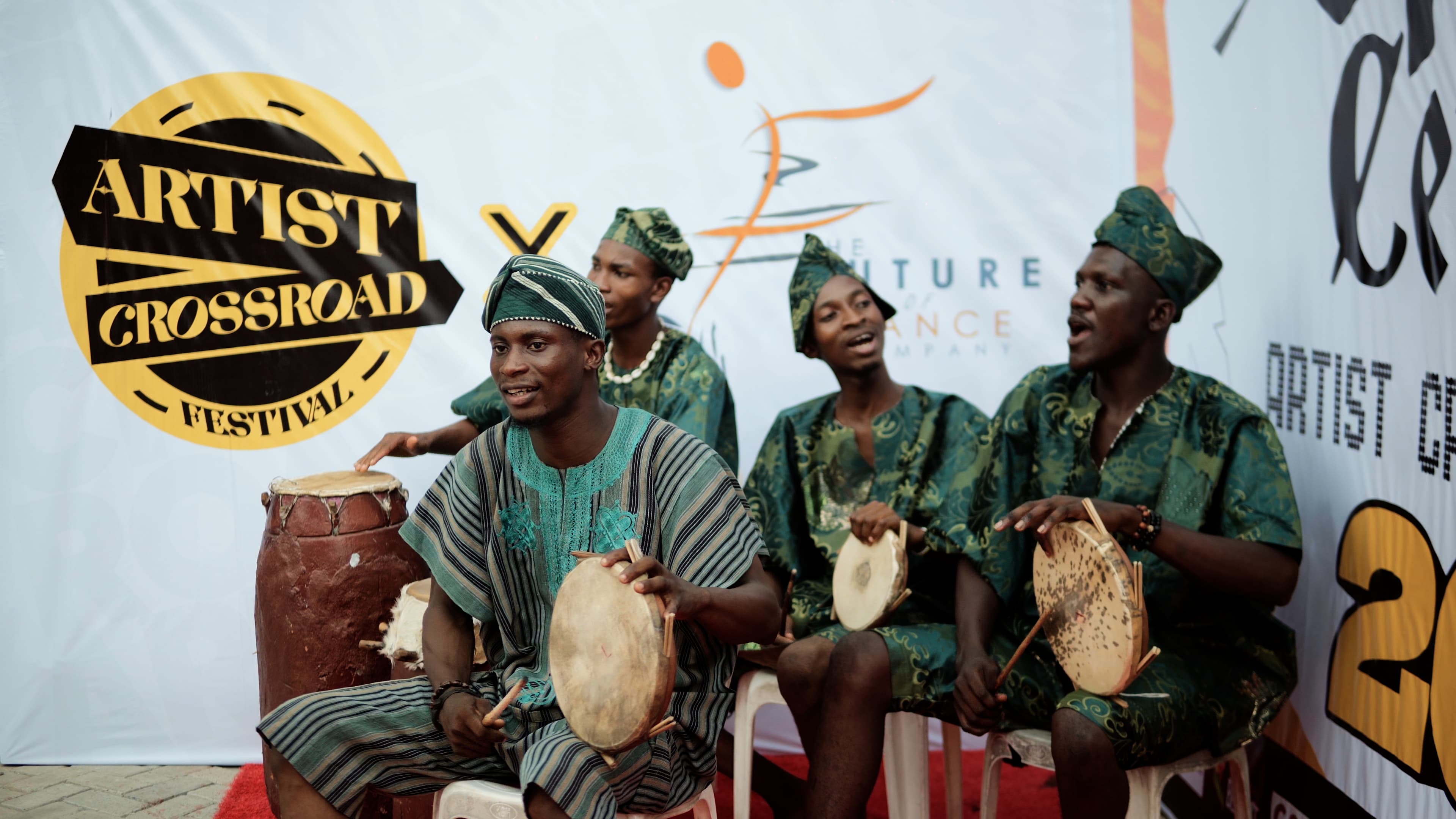
On April 14th, 2025, The Future of Dance Company—one of Nigeria's youngest leading dance companies focused on dance for social transformation—opened the fifth edition of its annual festival, Artists Crossroads. Marking its nine years of working in and with the Nigerian dance and cultural community and hosted at the newly renovated Centre for Contemporary Art (CCA), Lagos, the space has quietly borne witness to many waves of artistic expression over the years. However, this time felt different. There was a sense of grounding, a return, and a transformation of the space into a living, breathing arena of rhythm, memory, and movement.
At the heart of Artists Crossroads lies the remarkable legacy of The Future of Dance Company—a journey that began in 2015 through a collaboration of collectives determined to use art as a catalyst for change in Bariga and beyond. Their motto, “The beautiful ones are yet to be born,” is not just a statement of hope—it’s a call to action.
Over the past nine years, the company has pioneered a fresh language of movement—one rooted deeply in Nigerian and African indigenous traditions, yet fiercely contemporary in its urgency and style. Their innovative dance theatre works have unfolded in both traditional and unconventional spaces around the world, offering audiences not just performance, but presence—moments of cultural honesty that speak to power, identity, and possibility.
What makes their story even more compelling is their community-first approach. Most of their dancers and creatives are young artists from Bariga—a community often overlooked or stereotyped. Through their work, The Future of Dance Company challenges these perceptions, sparking conversations, elevating voices, and catalyzing action across the local and global stages. Their projects serve as a bridge—between the street and the stage, the local and the global, the ancestral and the futuristic.
By fusing dance, storytelling, and social consciousness, the company continues to empower marginalized communities while nurturing a new generation of cultural leaders. Their legacy is not just one of performance—it’s one of transformation, proving that art doesn’t just reflect the world; it rebuilds it.
Artists Crossroads, initially conceived as a platform to showcase the dance company’s work to their immediate community members consisting of students, parents, and community leaders, has grown into a full-fledged cultural movement. It now bridges generational gaps, blurs boundaries between institutions and street practice, and brings local and international artists together to celebrate, collaborate, and ask questions.
According to Ridwan Rasheed, the festival’s co-curator, the festival has over the years expanded its programming to include performances, skill-building workshops (often engaging non-dancers or non-artists), research projects, critical dialogue sessions, screenings, and showcases from both established and emerging talent across the globe. “Artists Crossroads has become more than just a celebratory event; it’s a strategic intervention for socio-political change—not only in the Bariga community but across Nigeria and beyond,” he said.
This year’s theme, Connecting the Dots, emerged from collaborations between artists and researchers from Nigeria, Austria, France, Germany, the Benin Republic, Togo, and Uganda. The theme emphasized the need to understand the complex historical relationship between Europe and Africa—not just through politics or trade, but through shared histories, identities, and creative expressions. The event’s opening night at CCA Lagos began outside the building with traditional songs and drumming, setting the tone for what felt like a symbolic homecoming. Guests moved through the building and gathered on the upper floor—formerly the CCA library—where the evening’s program unfolded.
The night opened with a stirring poem by Prince Uhunoma Charles, followed by a duet performance from Femi Adebajo (festival director) and Ridwan Rasheed (co-curator), addressing migration and the systemic injustices faced by African migrants. A short screening of the company’s first project from 2016 followed—an archival moment that grounded the audience in the history of their work.
This was followed by panel sessions that, for me, were the highlight of the night. Two major themes were discussed: “The Reality of Art in Nigeria: Struggle for Support and the Importance of Collaboration” and “Ethical Collaboration: Navigating Power in Transnational Art.” The panel featured powerful voices: Isioma Williams, Segun Adefila, Oyindamola Faithful, Seun Awobajo, Taiwo Ayedogbon, Jelili Atiku, NANTAP President Adeniran Makinde, Ambassador (Olorisa) Osagie Okedigan, and Joseph Edgar, and moderated by Omoregie Mary (Co-Curator). No one shied away from hard truths. That tension—the struggle between the sacredness of creation and the system’s demand for strategy, visibility, and monetization—became the heartbeat of the conversation.
Speaking on the panel, Mr. Williams reminded us of the importance of unity: “The artist must speak with one voice if they are to be taken seriously by the government.” The idea of unity is a good start, especially in the dance space where major names and cultural players still struggle to align their network and influence to push for national policies or collective infrastructure. Mr. Makinde, NANTAP’s President, reinforced this by stressing the need for long-term structures—not just one-off grants or promises. We all know policy has long been a problem. But it’s compounded by the fact that some individuals who’ve built systems for themselves have used their platforms to gatekeep rather than empower—repeating a dangerous idea: “I went through this the hard way, so you must too.”
I’m still unsure who coined that logic, but I’ve yet to forgive them.
Jelili Atiku, who led a workshop and research lab the following day, offered a profound challenge: “I choose to be Indigenous, even in this age of technology. We have to understand and determine what we want to be!” He went further, saying, “The youth are not waiting for permission. They’ve built their institutions on the street.” That line stuck with me. Because it’s true—young dancers and artists in Nigeria, and across the continent, are doing so much with so little. Their future doesn’t lie solely in the hands of policymakers or institutions. It’s already being sculpted—by collectives, crews, documentarians, choreographers who are building platforms, hosting residencies, shifting aesthetics, archiving work, and turning the street into both protest and performance. That quiet persistence is power.
Artists Crossroads is a living archive of what happens when youth claim space and culture. But I worry about the growing generational gap this pattern may continue to create—especially when support is withheld in the name of hard-earned struggle. The idea that younger artists must “suffer too” is, quite frankly, toxic and outdated.
Joseph Edgar added another dimension to the conversation, which was entirely agreed upon. In his words, “The arts must open up to new kinds of professionals—people from business, tech, and other fields who care about culture and can help build sustainable models.” But then, my question remains: are these other sectors willing to step in—not as dictators, but as collaborators? It’s disappointing that this topic continues to resurface across decades of artistic discourse. Are we destined to revisit this same conversation in every generation of Nigerian dance-making?
The opening night, after fierce discussions, ended in a quiet and joyful atmosphere: a cake-cutting ceremony to mark the company’s nine-year journey. Nothing flashy or formal. It was the perfect atmosphere of sharing time, thoughts, and joy.
After a week of research sessions and workshops led by Jelili Atiku, Emax Daniel, and Peter Okotor, the festival comes to an end today, April 20th. Artists Crossroads has proven itself to be more than just a festival—it’s a living space for reflection, bold expression, and the reimagining of future possibilities. At its core are the young dancers and creatives who are not merely performing but reshaping the cultural landscape, challenging the status quo, and sparking conversations that will echo far beyond the stage. Through their art, they are creating a future where their voices can no longer be ignored.
Catch the full experience now and dive into the vibrant world of the Artists Crossroads Festival, where art, culture, and innovation collide. This is more than just an event—it’s a transformative journey where the future of dance and creative expression unfolds, challenging the boundaries of art and society.