

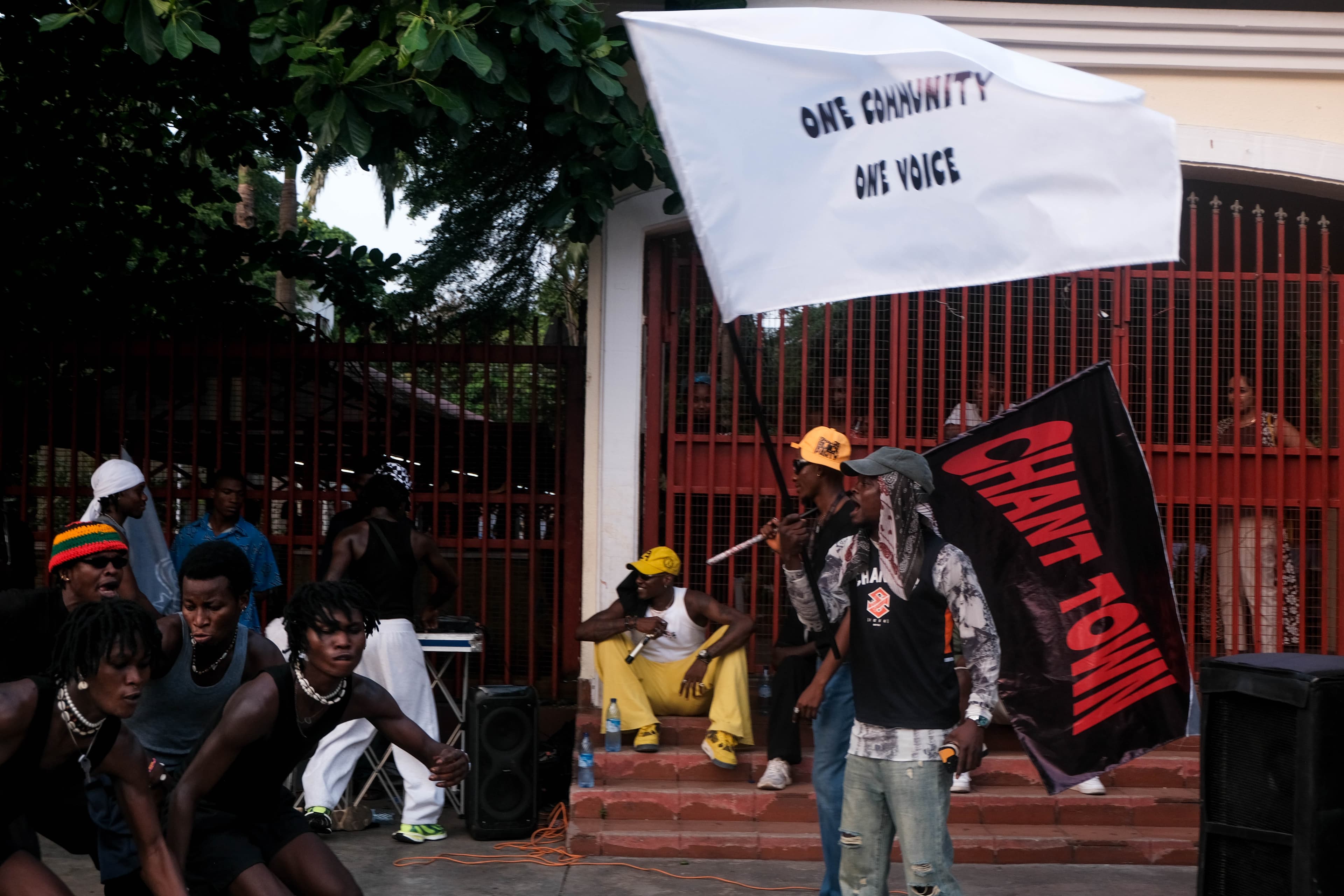
Afrocan returns in 2025 with purpose. After 4 years of quiet groundwork across the world, streets, studios, and digital spaces, the festival steps back into public view with “Chant-Town,” a theme shaped by the conversations, tensions, and creativity moving through African dance communities today. It’s a clear and bold return that reflects a generation that creates without needing permission or spectacle.
Across West African street dance culture today, there is a noticeable shift, a quiet confidence and an ease in how young dancers create, experiment, and respond to their realities. You see it in how they pull from everyday life, in how their bodies connect to sounds and styles moving across borders, and in the growing sense that movement is its own form of authorship. Afrocan’s Chant-Town edition, taking place from the 16th to the 21st of December, aligns directly with this moment. It doesn’t attempt to define the culture; it steps into a current already in motion.
Afrocan has become a word that captures a shared generational presence. It carries the looseness of contemporary youth culture, the discipline of dancers shaped through community training, and the cross-border spirit that defines how young Africans collaborate today. The name is less about defining Africa and more about recognizing how African dancers already reshape space, sound, and connection. It gives language to a cultural possibility that older generations rarely practiced; a horizontal way of building, where community matters more than hierarchy.
This year marks Afrocan’s first return as a full festival in seven years with its Chant-Town edition. It’s an ambitious but grounded attempt to convene dancers, culture workers, and young creatives from across Africa and Europe. The festival does not claim to be the continent’s cultural vanguard, nor does it position itself as the singular force shaping Africa’s creative future. Instead, it functions as a meeting point, a deliberate space where movement, history, and community sit beside one another without performance, pressure, or expectation.
The dance festival arrives at a moment when young African culture workers are reshaping what cultural work looks like and building what can only be called soft infrastructures: improvised rehearsal rooms, personal studios, online collectives, roving workshops, and informal systems of training and mentorship. These spaces rarely make headlines, but they keep cultural life breathing. Afrocan plugs into the ecosystem as one node within a much larger, self-organized network stretching across Lagos, Abidjan, Barcelona, Nairobi, Accra, Johannesburg, and Luanda.
Ease shows up repeatedly in Afrocan’s language. Ease of movement, collaboration, stepping into a circle, and responding to whatever rhythm arrives. This isn’t accidental but a deliberate stance in a cultural landscape that often demands polish and spectacle. Afrocan’s comfort feels like an intentional alignment with honesty, a rejection of exhaustion, and a refusal to participate in the performance of struggle and elitism. Afrocan is a belief that scarcity shouldn’t legitimise creativity. Although it’s impossible to state whether Afrocan’s claim of ease was intentional from the beginning or arose from necessity. What matters is that it has become a signature of the movement; a grounded, unforced way of working that allows dancers to show up fully without pretense.
Founded in Bariga, Lagos, on July 25, 2018, by Yemi Osokoya, Afrocan started as a practical intervention: a place where Afro dancers from different crews, and communities could claim identity, standards, and mutual support. Today the movement is guided by a five-member committee: Osokoya, Amaechina David (Snipes), Ambrose Idemudia (Tjark), Akeredolu Oreoluwa (Kredol), and Obiajulu Ozegbe (Valu), positioned to respond to the industry’s chronic underrepresentation, lack of communal platform and fragmentation.
The festival’s choice of Lagos already carries meaning, but its location at Freedom Park deepens that narrative. Once Her Majesty’s Broad Street Prison, the site that formerly held political dissidents now stages artistic gatherings, debates, and reimagination. Afrocan’s presence there signals a reclamation of space; it folds dance into a longer Nigerian story of resistance and recovery. Movement itself becomes a form of historical re-inscription, turning past struggle into usable memory for a generation shaping its own creative future.
A festival committed to cross-border exchange fits naturally inside a venue transformed from confinement to openness. Here, dance becomes less of a performance and more of a practice of freedom. African bodies once confined now return through workshops, battles, performances, collaboration, dialogue, rave and collective gathering. The space carries memory, and dance activates that memory without needing to preach. Afrocan at Freedom Park becomes a site where movement absorbs history and releases something new.
What does it mean for a dancer to arc their spine where people were once forced into submission? For a community to gather in joy where pain was once enforced as policy? Afrocan lets these questions sit in the body.
Afrocan’s pan-African ethos extends its gaze beyond Nigeria and reflects the daily reality of dancers across the continent. Movement vocabularies already travel freely through WhatsApp groups, Instagram loops, rehearsal exchanges, and cross-border friendships. But the presence of Ivorian dancers Ordinateur and Oulouy makes this circulation visible and grounds the festival’s continental pulse. The work of Miss Lulu, a Nigerian dancer who has mastered Azonto, a Ghanaian form, further shows how West African styles adapt, travel, and gain new meaning across borders.
These artists as well as other dancers facilitating at the festival are part of a larger, continuously evolving Afro-syncopated network: a real-time remixing of identity through movement. Afrocan gives this network a physical container and makes the continental connection intentional.
The festival remains relevant because it gathers people already doing the work. It fills the gaps that formal institutions continue to overlook: affordability, belonging, continuity. It offers a space where learning, experimentation, and community-making can happen without hierarchy or bureaucracy.
For many dancers, the festival may not be a dramatic turning point, but it will matter. It offers the chance to train, connect, be seen, and breathe inside a wider creative landscape. And sometimes that is enough to shift how a practitioner imagines their place in the culture.
The Chant-Town theme draws from the idea of chant as both memory and forward motion. Chant is what people repeat to remember who they are. Chant as insistence and the rhythm that turns into dance.
Within this frame, the festival functions like a laboratory: workshops where dancers learn from one another across ideas and techniques; street sessions and battles that blur the line between spectator and performer; elders circles where the wisdom of elders, the curiosity of youth, and the urgency of the now become visible in dialogue; Owambe Lagos, a tribute to the city’s rich party culture where fashion, food, and music converge; a Dance Production Showcase Marathon, featuring original productions from Nigerian and diaspora collaborators; and the Afrocan Dance Blast & Concert, the grand finale with guest artists, live musicians, cyphers, and high-energy performances that reflect the complexity of African urban movement culture.
But Afrocan’s meaning extends beyond its program. It captures a generation’s desire to be seen not as emerging, not as potential, not as underdeveloped, but as participants in shaping culture right now. It signals a shift from validation to self-authorship. And it grounds this shift not in theory, but in practice, in the way dancers gather, share, innovate, and move.
What distinguishes Afrocan most is its ease. It is bold without posturing, ambitious without exaggeration. It behaves less like an institution and more like a gathering shaped by the people who show up; a movement that works because it does not try to be more than it is.
In that sense, Afrocan mirrors the continent itself: complex, young, dynamic, constantly reshaping its definitions of culture. If Chant-Town succeeds, it won’t be because it was perfect. It will be because it was true to the people who built it and the culture that sustains it. Afrocan is already part of a larger story making its way through African youth culture. The festival simply gives that story a place to land, a space to breathe, expand, and speak without interruption.
Picture by: Damilola Bankole. Video by: Yemi Osokoya & Oreoluwa Akeredolu
“Hosting Afrocan at Freedom Park was intentional, not for entertainment, but because the site's history stands in sharp contrast to Afrocan's core intention: to build a space where Africans can move, learn, and express without limitation. Freedom Park carries the memory of confinement; Afrocan embodies release.”
Yemi Osokoya, Founder, Afrocan