

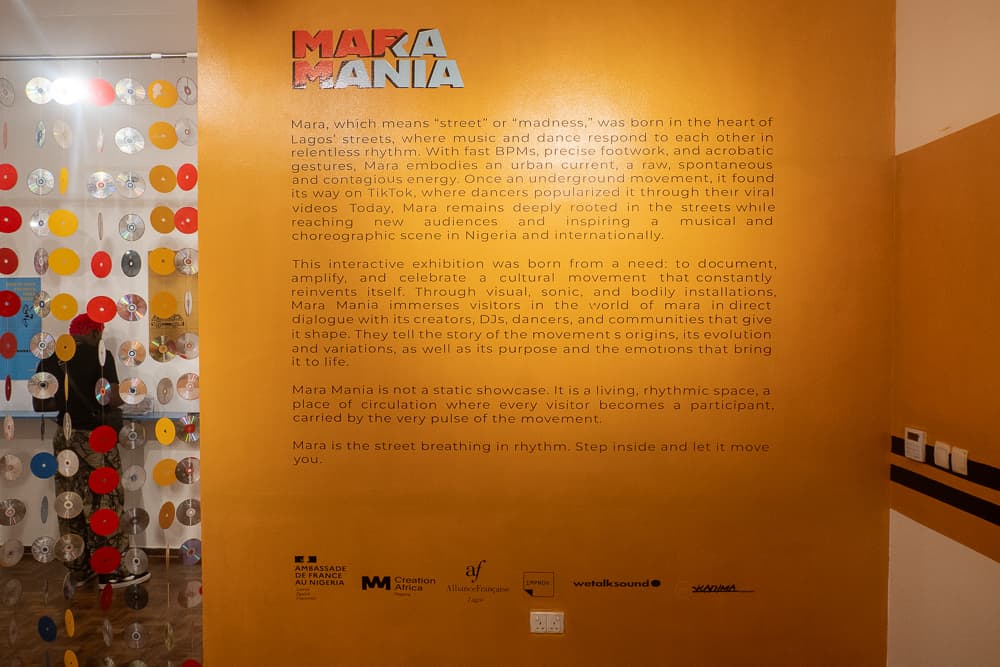
Mara Mania arrived as a coordinated effort to give Lagos’s Mara dance culture a formal cultural moment, not by diluting its street DNA, but by reframing it through collaboration, documentation, and institutional support. A joint initiative by Kadima Production, Improve, Alliance Française, WeTalkSound, Creation Africa, and the Embassy of France in Nigeria, the project demonstrated what happens when a grassroots movement receives both cultural infrastructure and strategic curation.
The two-part program, an exhibition at Alliance Française and a film-and-performance gathering at WAF Skate Park, operated like a controlled experiment in how street culture can scale when placed in structured environments.
The Alliance Française exhibition served as the intellectual anchor of the project. Instead of simply presenting Mara as a viral trend, it outlined the culture’s formation: the neighbourhoods where it took shape, the sonic logic of Mara and cruise beats, and the choreography patterns that now circulate widely on social media. The curatorial approach was intentional. By segmenting the exhibition into origin, evolution, and community influence, the organizers positioned Mara as a full-fledged cultural practice, not an internet dance challenge.
For an audience that included dancers, cultural workers, and first-time observers, the exhibition created a shared baseline. It allowed people to understand Mara not just as a movement, but as a language shaped by Lagos’s pace, informality, and youth-driven creativity.
At WAF Skate Park, the event shifted from analysis to immersion. The screening of the Mara Mania documentary offered a more narrative view of the movement; who sustains it, how it spreads, and why it resonates with young people navigating Lagos’s unpredictability. The framing emphasized participation over performance; the dancers as well as the DJs were shown as cultural drivers, not entertainment accessories.
The subsequent live segment, featuring pioneers DJ Khalifa, DJ Cora, DJ Tobzy, and Azzi on the Beat, functioned less like a concert and more like a practical demonstration of Mara’s sonic ecosystem. Choices in instrumentation, BPM, viral audio cues, and rhythmic emphasis highlighted how producers shape the movement as decisively as dancers do.
Skilo Richie, one of the dancers redefining the form, continues to add another interpretive layer. Alongside co-pioneers like Larry, Baggy, Zenny B, and King Kong Mara, he represents a generation experimenting with Mara’s vocabulary in real time. Their work reinforces a growing idea in Nigeria’s dance space: some dancers now operate as cultural interpreters, able to translate street energy into stage-ready language without losing authenticity.
Kadima’s continued visual documentation also serves as cultural preservation and amplification, sharpening how the movement is represented and understood. The crowd’s response made clear that Mara Mania successfully bridged both cultural insiders, who understand the coded nuances, and a wider youth culture drawn to Mara’s sound, movement, and energy.
The project’s strongest signal came from its partnership model. By involving Kadima Production, Improve, Alliance Française, WeTalkSound, Creation Africa, and the Embassy of France in Nigeria, Mara Mania benefited from the convergence of documentation expertise, music culture networks, youth-community structures, and institutional legitimacy. This coalition demonstrated what effective cultural backing can look like when it respects the autonomy of a street-born form.
What lingers after Mara Mania is less the excitement of the night and more its implications.
It demonstrated that Mara can survive translation into curated spaces without losing its edge. It signaled that cultural institutions in Nigeria are becoming more open to recognizing dance subcultures as legitimate bodies of knowledge, not just performance commodities. And it highlighted what happens when creatives stay committed to depth over polish, experimentation over perfection, and grassroots truth over elitist expectations.
For a movement that has long existed at the margins, Mara Mania showed that strategic collaboration; grounded in authenticity; can build platforms that reflect the complexity of contemporary Nigerian youth culture and attract global attention.
Mara Mania didn’t attempt to “upgrade” the culture; it clarified it.
And that clarity is what will push the movement beyond virality and into continuity.
The exhibition continues at Alliance Française until December 20th for anyone who wants to understand how Mara moved from neighbourhood corners into the wider cultural conversation, the Mara Mania exhibition at Alliance Française is essential viewing. The showcase provides the context often missing from the trend cycle: the roots, the dancers, the sound-makers, and the creative systems that shape the culture. If you care about Lagos street culture, youth creativity, or how movements evolve, go experience it; the insight is worth the visit.
Picture Credits: Damilola Bankole