

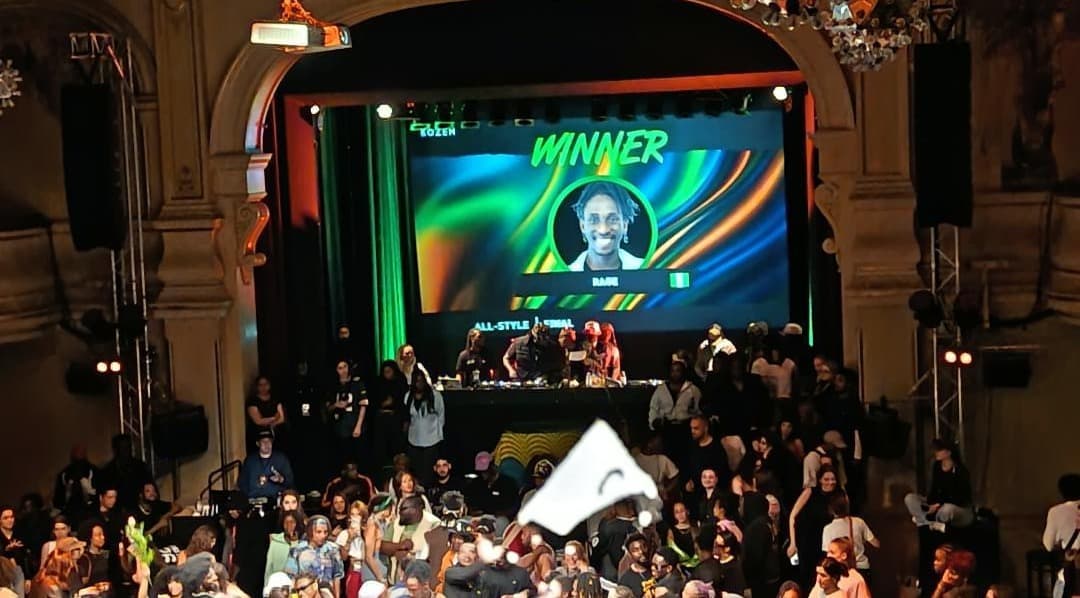
There are moments in culture that quietly rearrange how a country must be seen. Not because governments announce or institutions immediately support them, but because the image itself becomes undeniable. Two Nigerians. Two friends. Two dancers shaped by the same cultural atmosphere travelled to Germany for the CDC festival, one of the world’s most respected African and Caribbean street dance festivals. They entered the Culture Concept battle competition alongside dancers from different countries, cultures, and dance styles. By the end of the battle, both finalists were Nigerian: Ekwem Charles Eze “Rage” Oche and David “King Davici” Anietientabasi.
A final battle. Nigeria faced itself at the highest point of an international competition. Rage emerged as the winner, and Davinci placed second. It was the first time a Nigerian had won the Culture Concept Battle and two Nigerians occupied top positions. The significance of that moment extends beyond dance to say something about where Nigerian culture currently stands in the world and how dance has become one of the country’s most important cultural identities.
Nigerian dancers have long upheld international standards within local spaces, developing movement vocabularies through battles, parties, music videos, church performances, nightlife, road shows, festivals, and community exchanges. This work happened outside formal systems of recognition, yet the dancers continued building, competing, and refining their craft. Thus, dear readers, this isn’t simply a feel-good story about solo talent but evidence of a scene that has been building for years.
One finalist can be interpreted as an exceptional talent. But, two Nigerians reaching the final battle of the same international competition points to something larger: a living ecosystem of mentorship, friendship, and continuity. It suggests that Nigerian dance is no longer producing isolated moments of brilliance and solo genius, but a generation with its own movement identity and cultural confidence. Thus, when you see dancers at the national stadium training day and night, at freestyle Friday yearning to perform, or filming at any available spaces in Lagos free of area boys, take a moment to recognise that this is the typical sowing season.
Nigeria has always produced cultural excellence under difficult conditions. From literature to football, music to film, the country repeatedly exports forms that reshape global culture. Dance belongs within that lineage. For years, the Nigerian dance has travelled across the world promoting Afrobeats, concerts, music videos, clubs, brands, festivals, street cultures, film, and engaging in social issues. Yet conversations around African cultural export often centre on music, film, and fashion, while dancers remain in the background despite carrying much of the culture through the body itself. What happened at the CDC festival forced attention back onto the dancers.
Rage’s victory itself did not emerge out of nowhere. He has, since 2020 built one of the strongest competitive run by a Nigerian street dancer in recent years: winning the Glo BOTY Krump Category in 2022, claiming the Red Bull Dance Your Style Nigeria title in 2024, winning alongside Davinci at Afropolis GAVE Nigeria 2024, defending his title at the Bullet Dance Challenge in both 2025 and 2026, and winning the WFADS 2026 African Championship while representing Nigeria in Senegal. CDC becomes another chapter in that growing history.
The CDC win carries historical significance. That the win happened in Germany, particularly within the broader context of Berlin’s relationship with Africa since the Berlin Conference of 1884 is important. The city once associated with the political partitioning of Africa became the site of a cultural moment where African bodies occupied the centre of global attention on their own terms. Thus, when two Nigerians meet in the final battle of an international competition in Germany alongside fellow African and Black dancers from across the diaspora, history is confronted with a different image of Africa: not one defined by extraction or limitation, but by innovation, discipline, and cultural force.
That is why the moment matters beyond the likes and repost. It unsettles long-standing assumptions about where excellence is expected to come from and who gets to shape global culture. Nigerian dancers have already been building that future. The world is only beginning to catch up. Rage’s win signals his greatness. But, two Nigerians reaching that final stage means the movement language developed within Nigerian dance spaces can no longer be treated as peripheral but part of the global standard now.
The most powerful part of this story is that the final battle happened between friends. There is something deeply moving about two people shaped by the same environment, childhood, who are members of the same group, and attended the same dance school (The Dance Deal Training Foundation) meeting each other at the peak of an international stage. It transforms the moment from individual success into evidence of a living cultural and communal movement.
Years from now, people may look back at this culture concept battle final at CDC as one of those defining moments when the world could no longer ignore the scale of Nigerian dance culture and the force it had been quietly building for years. A moment when Nigerian dance stopped being viewed merely as accompaniment to Afrobeats music and began to be recognised as a serious cultural force on its own terms.