

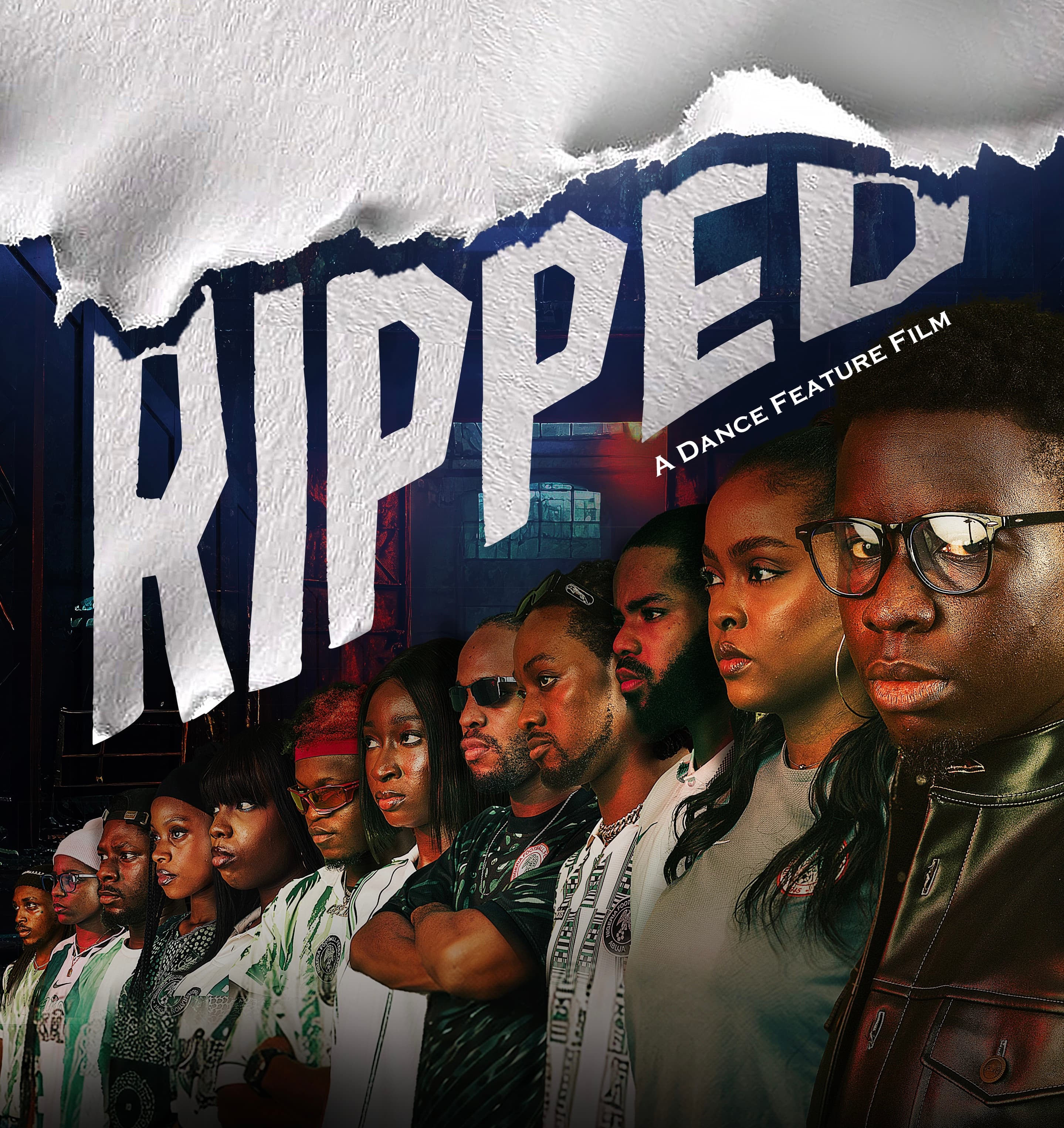
For as long as Nigeria’s creative industries have been documented, dancers have largely occupied the background of the frame, choreographing the music video without a screen credit, animating the Nollywood party scene without a character name, teaching the viral step without owning the archive it becomes. Dance has powered the visual economy of Afrobeats and film alike, yet it has rarely been trusted to author a story. It has been treated as texture: something a narrative moves through, not something a narrative moves because of. This is the quiet imbalance that a new film, RIPPED, steps into, less a corrective statement than an act. BeatNFeet, a collective of dancers has written and directed a narrative dance feature, placing dance not at the margins of the frame but at its centre of gravity, and in doing so, reopening the question of who gets to narrate the body on screen.
What is significant about RIPPED is not whether it succeeds as entertainment, or breaks even at the box office, but what its existence represents structurally. It marks a shift from dance as mere spectacle to dance as the origin of a considered, authored work of art, from being choreographed for the camera to choreographing the camera itself: its flow, its cuts, its performances. This is dance leaving the proscenium, the battleground, and the video-vixen frame all at once, entering cinema as a language of meaning-making rather than a decorative interlude between scenes.
It also signals a redistribution of authority over cultural narrative. When dancers direct, they determine how movement is read, how their stories and lived experience are contextualised and remembered, a form of custodianship too often surrendered to choreographers-for-hire, music video directors, or platforms optimising for fifteen-second virality, to say nothing of a longer history of dancers portrayed with little agency of their own. RIPPED, by virtue of who made it, insists that the people who carry the embodied knowledge of a form should also be trusted with its representation.
There is, further, an interdisciplinary claim embedded here: that dance practice is compatible with directing, editing, world-building, and screenwriting; that the studio and the cinema are not separate professional universes but adjacent literacies. This matters for career infrastructure, within the dance sector and beyond it. It expands what a “dance career” in Nigeria can plausibly include, beyond performance, dance workshops, and commercial choreography, into producing, directing, and cultural authorship. For a young dancer watching from a rehearsal space in Surulere or Kaduna, RIPPED changes the horizon of what training can lead to.
None of this happens in isolation. RIPPED arrives inside a broader diversification already underway across Nigeria’s dance ecosystem: the rise of dance research platforms like Moving Grounds Journal, movement-based curation like Qdance’s Dance Lab and the Duniate festival, and a new generation of collectives documenting technique as cultural heritage rather than a passing trend. Whether or not RIPPED becomes a commercial landmark, its premiere is evidence of an ecosystem maturing beyond performance alone, one increasingly capable of producing its own theorists, archivists, and now, its own filmmakers. That shift, more than any single film, is what deserves attention before the lights go down.
Below are four things you should know about the process and goal of the film RIPPED by BeatNFeet.
At what moment did you realise this story needed to become a film rather than a stage production?
Khalid Balogun (Writer):The story was always written to be a film. We wanted to tell it through a medium that could show the world what creatives in Lagos truly face, this is a very touchy subject, but one every creative in Nigeria can relate to, given our systems and our environment. Film remains one of the most powerful ways to pass a message to a large audience; visual media is one of the top points of communication today. That was always the plan.
What were the biggest creative or production challenges in translating a dance story into cinematic storytelling?
Khalid Balogun (Director):Balancing dance and acting on set was the first challenge. Every dance sequence needed its own coverage and detail, and so did every acting beat, making sure neither suffered for the other, with limited time, was difficult.
The second was creative: making sure dance never became just a display of aesthetics. We didn’t want to lean too heavily on dialogue, since dance was our main storytelling tool, but every sequence also had to correlate to the scene and push the story forward, not just look good.
The third was scale. We had close to a hundred people on set across thirteen locations, cast, crew, extras, welfare staff. Directing that meant managing not just actors and dancers, but everyone behind the camera too, and keeping everyone in tune with fatigue, punctuality, and continuity. Asking a dancer to deliver a demanding scene and then immediately switch into emotional dialogue took a lot out of everyone.
And then there was reality intruding on fiction: during one shoot, we were nearly harassed by touts demanding money, and it almost turned physical. It was surreal, the very thing RIPPED is about was happening to us in real time, on set. If anything, it confirmed we were telling the right story.
How did your background as a dancer influence the way you approach acting for the camera?
Badmus Temitope (Actor):As dancers, we always could tell stories with our bodies, so dancing for the camera felt like a walk in the park. Acting was the harder part, this was one of my first major roles. But dance shaped how I approached it: exaggerating movement and using the body to communicate what dialogue alone couldn’t. If a character is depressed, the body has to look relaxed, the face has to look calm, it’s about controlling your muscles to match your words. That discipline, alongside my background as a creative arts student at the University of Lagos, is what really helped me merge the two.
Beyond the premiere, what conversation do you hope RIPPED begins within the dance community and with wider audiences?
Mayorflexx, Fatboy, Emiking, Khalid, Desa, Olaprime & Tybe (Producers):Beyond the premiere, we hope RIPPED becomes a catalyst for deeper conversations about the realities of the dance community, around collaboration, sustainability, representation, and building a stronger ecosystem for artists in Nigeria, including the case for a union. For wider audiences, we hope it shows that dance can be a language for issues that extend far beyond the stage, and that the conversation continues long after the curtain closes.
The hardest part of translating a dance story to film was turning body language into cinema language. On stage, an audience feels energy instantly, the breath, the sweat, the vibration of movement. On camera, that same energy disappears unless you make deliberate choices: when to go close for emotion, when to pull wide for the full movement, how to cut so the edit itself feels like part of the choreography.
Shooting on Lagos roads was its own challenge. RIPPED’s story was born from harassment and struggle in outdoor spaces, so we insisted on filming in those real environments, which meant navigating crowd control, noise, and safety with very little room for error.
The hardest shift, though, was for the performers. Dancers are trained for the stage or for short-form video; film asks for something else, truth in the smallest gesture, a look, a breath, an awareness of continuity that the stage never demands. RIPPED is not just a dance film. The difficulty of making it is stitched into every frame, because it’s Lagos’s story, and ours.
We hope RIPPED sparks a wider conversation about the realities creatives face simply trying to exist and work in Nigeria, including how informal systems like agbero culture can disrupt, intimidate, and endanger creative expression. We want people across dance, film, and content creation to ask harder questions of government: how do we protect our spaces? How do we build safer structures for creatives to work in? And for wider audiences, we hope it builds awareness of the unseen struggle behind the art they consume, loud enough, ideally, to move government toward protecting artistic environments and recognising these issues as part of a larger, urgent gap.