

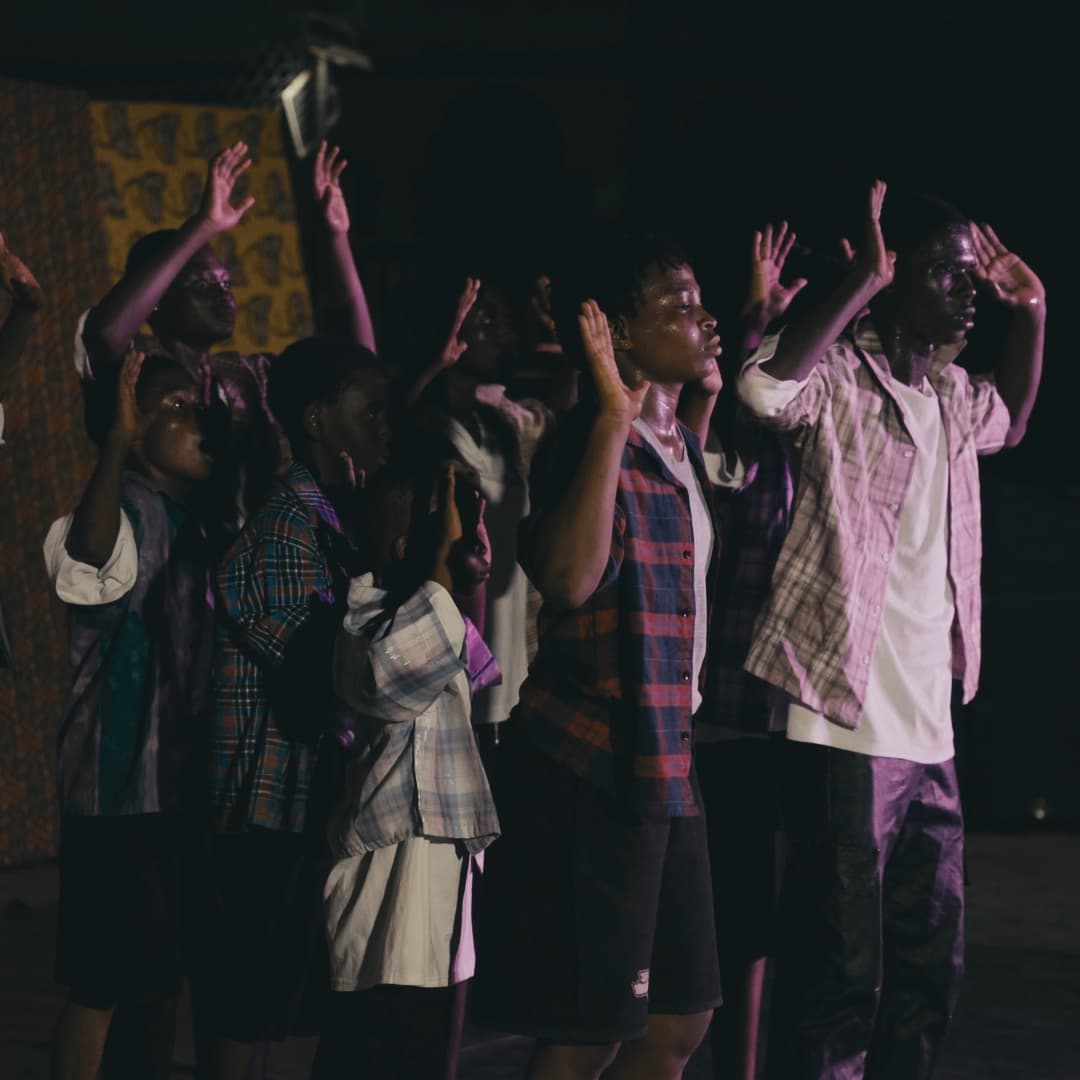
What do Nigerian children inherit when fear becomes part of their childhood stories? This question followed me through the Ennovated Dance Academy’s Tales by Moonlight, a performance production intended to celebrate 2026 children day. That it happened amidst fresh reports of coordinated school kidnappings in Borno and Oyo States made it impossible to witness the performance without thinking of the kidnapped children. The question returns: What do Nigerian children inherit and tell when tragedy monopolises their childhood stories?
On 29 and 30 May 2026, Ennovated Dance House, led by Obiajulu Ozegbe, presented Tales by Moonlight, a new work performed by the children of Ennovated Dance Academy and conceptualised and choreographed by Chima Obasi as part of Children’s Day celebrations. Tales by Moonlight draws inspiration from the familiar tradition across Africa: peaceful evenings where elders gather and share tales of talking animals, mythical beings, cautionary lessons, and communal wisdom to children. These entertaining stories served as tools for teaching values, imagination, and belonging. However, with Ennovated Dance House, the stories were told by children, through bodily movements, minimal spoken words, and unlimited music.
The children entered the performance stage carrying black-painted plastic jerrycans marked with white-inscripted faces of sad kids, referencing the recent kidnaps. The objects shifted in meaning as the piece unfolded, becoming school bags in the dancers’ hands. They moved across the stage with an unsettling sense of urgency before arranging themselves in a straight line, like soldiers preparing for battle. Beating rhythmically against the jerrycans, they created an image that was playful and unsettling. The audience responded with delight, impressed by the children’s confidence, character, and stage command. But, a disturbing moment and image was present as what began as a play briefly took on another meaning. For those brief moments, they looked less like children preparing for stories but a generation forced to reckon with realities no child should witness nor inherit.
Tales by Moonlight was meant to celebrate the brilliance of Oworonshoki’s children whom Ozegbe and his team have spent years nurturing through dance, with their parents or family members present to see their children’s talent. Yet as I watched, it became increasingly difficult to separate the celebration from the news cycle that defined May. 2026 Children’s Day arrived carrying another tragic story. Earlier in May 2026, over 80 schoolchildren were reportedly abducted in coordinated attacks across Borno and Oyo States. Their absence lingered beyond the headlines and found its way into spaces and time where childhood was supposed to be celebrated.
“The current situation in Nigeria made it impossible to create this work without acknowledging what is happening,” Ozegbe said before the performance. “We want the victims returned safely to their parents.” The performance, which featured nine children, ultimately became an act of solidarity. In one section of the piece, a spoken-word performance led by Precious Yeri and written by Tobi Abiodun was dedicated to the victims, challenging systems that continue to fail children, and questioning what it means to grow up in a society where safety isn’t guaranteed. “When the government turns a blind eye to the suffering of our children, we will not stay silent. We will fight”, the poem read. The performance had an infused sound which features a teacher’s voice extracted from a viral video commanding kids to be in a straight line. In that viral video, the happy children were dancing and enjoying themselves like they had won a lottery. But, watching the young dancers perform to that sound made me reflect on the viral video again. It made me ponder on the level of joy, freedom, and liberty most children yearn for, and breaks my heart that only children with affluent parents or families connected to the 5G of God fathers and tycoons as said in the poem of the dance can have this dream. For the performing, kidnapped, and low-income-family children, the joy and freedom of childhood has been stripped off them. The piece ended with the dancers pouring water from a jerrycan painted with the sad face of children, and immediately, the dancers transformed. It felt like a ritual, a cleansing. It could be said that the performance was refusing to let grief be the final image of childhood.
Whether the country can offer children the same possibilities is another question entirely. What tales will these children tell their own children one day? What memories of childhood will remain in their bodies? Will the mythical characters of future moonlight stories be replaced by men with masks carrying machetes and guns? Will fear become as familiar to childhood as imagination once was? The tragedy of these school kidnappings isn’t only that children are taken but that entire generations of Nigerian children will inherit fear as part of their childhood lore. And, in a country where tales-by-moonlight stories have taught courage, community, and hope, it’s devastating the stories Nigerian children are now witnessing. The question remains: What stories will these children tell their children?